Most scaling methods take a programme of work and divide it into fixed feature teams, with their hidden dependencies, padded estimates, and Gantt charts masquerading as a product backlog. They assume that the process of forming, storming, norming and performing, known as the Tuckman model, is expensive and time-consuming for a new team, so they establish stable, long-lived feature teams and then try to figure out how to split the work up.
In contrast, Demand-Led Planning1 starts with the demand. We assemble teams dynamically around the business priorities and we review and modify these structures on a regular cadence. Our experience—and subsequent research—tells us that a group of motivated and well-supported individuals can gel into high-performing teams in a matter of hours or days rather than weeks or months, especially when they get to choose what they work on.
Each quarter, we gather everyone together and make all of the upcoming demand visible. Not only product development work like features and customer research, but all the day-to-day effort of running a business: maintaining systems, supporting customers, running reports, responding to outages, as well as evolving the system of work itself: process improvement, automation and tooling, learning and development, recruiting and on-boarding.
Various stakeholders ‘pitch’ the demand for the quarter to all the participants—anything from 20 to 200 people—and they self-organize into teams that can meet this demand.
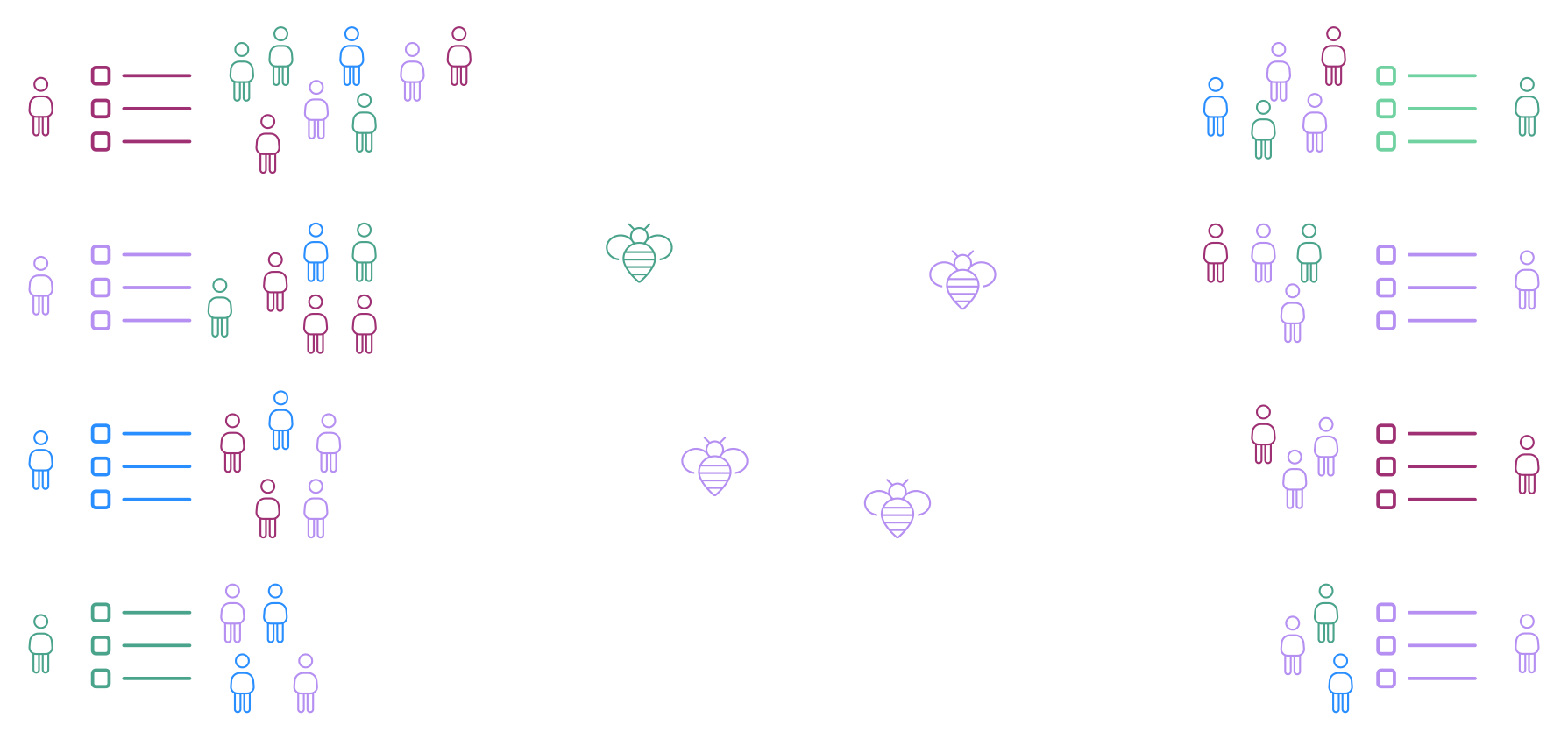
People self-organize around the work; some are ‘bumblebees’ who will float between teams
This exercise takes 1-2 days per quarter, depending on the size of the programme and the maturity of the team. The impact on both motivation and results is profound. People feel more engaged with their work; they understand how their work contributes to the programme’s mission; they feel they have agency to decide what they will work on, where they can contribute, learn or both.
The productivity of the programme measurably improves, often by more than double, without compromising quality, as the team gets to focus on what matters.
Note: Most programme teams are not ready to ‘just start’ with demand-led planning. Instead, we start by exploring all the reasons why ‘it will not work here’—and address these one at a time until the team is ready to give it a try.
has over a decade of experience implementing demand-led planning in retail giants, regulated environments like banks, hedge funds and trading firms, traditional telcos, and many other environments.
Daniel gave a talk about Demand-Led Planning at Craft Conference 2025 ↩︎